# T4 Refraction (Milestone 2)
### T4.1 Add refract() to calculate the refrac vector direction (vec3.h)
Add refract() in vec3.h to calculate the refrac vector direction
Add refract() at the end of vec3.h, outside the vec3 class.
```cpp
inline vec3 refract(const vec3& uv, const vec3& n, double etai_over_etat) {
auto cos_theta = std::fmin(dot(-uv, n), 1.0);
vec3 r_out_perp = etai_over_etat * (uv + cos_theta*n);
vec3 r_out_parallel = -std::sqrt(std::fabs(1.0 - r_out_perp.length_squared())) * n;
return r_out_perp + r_out_parallel;
}
```
### T4.2 Add dielectric material (material.h)
Add class dielectric in material.h
dielectric inherits from material and implements its scatter method using refract()
class material {
//...
};

class lambertian : public material {
//...
};

class metal : public material {
//...
};

//>>>>>>>>>>>>>>>>>>>>>>>>>>>>>>>>>>>>>>>
class dielectric : public material {
  private:
    // Refractive index in vacuum or air, or the ratio of the material's refractive index over
    // the refractive index of the enclosing media
    double refraction_index;

  public:
    dielectric(double refraction_index) : refraction_index(refraction_index) {}

    bool scatter(const ray& r_in, const hit_record& rec, color& attenuation, ray& scattered)
    const override {
        attenuation = color(1.0, 1.0, 1.0);
        double ri = rec.front_face ? (1.0/refraction_index) : refraction_index;

        vec3 unit_direction = unit_vector(r_in.direction());
        // refract vector
        vec3 refracted = refract(unit_direction, rec.normal, ri);

        scattered = ray(rec.p, refracted);
        return true;
    }
};
//<<<<<<<<<<<<<<<<<<<<<<<<<<<<<<<<<<<<<<
### T4.3 Update the scene (main.cpp)
Change material left from metal to dielectric in main()
```cpp
void main() {
hittable_list world;
auto material_ground = make_shared(color(0.8, 0.8, 0.0));
auto material_center = make_shared(color(0.1, 0.2, 0.5));
auto material_left = make_shared(1.50); // <<<<<<<<<<<<<<<<<<<<<<<<<<<<<<<
auto material_right = make_shared(color(0.8, 0.6, 0.2));
//...
}
```
### Build and Run Your Program
If building is successful, run your program in the terminal as follows using your executable name
```
./ray01.exe > image11.ppm
```
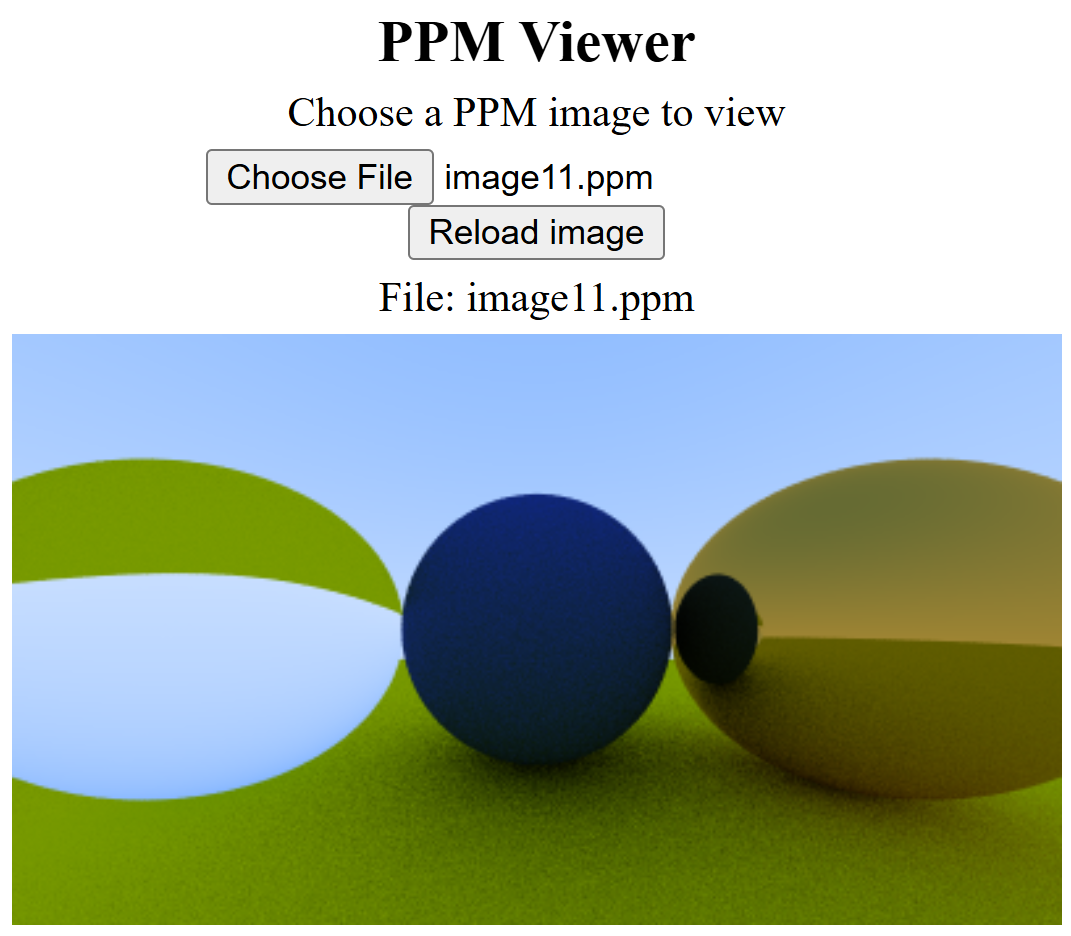
It is slower then reflection as more refracted rays are involved.
If successful, you are going to see a lovely photo like the following
It is very interesting to notice that you see the sky colour through the bottom half of the glass sphere due to refraction.
### T4.4 Add total internal reflection and Schlick Approximation in
Revise the satter() method in class dielectric to add total internal reflection, and schlick approximation for Fresnel effect.
```cpp
class dielectric : public material {
private:
// Refractive index in vacuum or air, or the ratio of the material's refractive index over
// the refractive index of the enclosing media
double refraction_index;
//>>>>>>>>>>>>>>>>>>>>>>>>>>>>>>>>>>
static double reflectance(double cosine, double refraction_index) {
// Use Schlick's approximation for reflectance.
auto r0 = (1 - refraction_index) / (1 + refraction_index);
r0 = r0*r0;
return r0 + (1-r0)*std::pow((1 - cosine),5);
}
//<<<<<<<<<<<<<<<<<<<<<<<<<<<<<<<<<
public:
dielectric(double refraction_index) : refraction_index(refraction_index) {}
bool scatter(const ray& r_in, const hit_record& rec, color& attenuation, ray& scattered)
const override {
attenuation = color(1.0, 1.0, 1.0);
double ri = rec.front_face ? (1.0/refraction_index) : refraction_index;
vec3 unit_direction = unit_vector(r_in.direction());
vec3 refracted = refract(unit_direction, rec.normal, ri);
// >>>>>>>>>>>>>>>>>>>>>>>>>>>>>>>>>>>>>>>>>>>>>>
double cos_theta = std::fmin(dot(-unit_direction, rec.normal), 1.0);
double sin_theta = std::sqrt(1.0 - cos_theta*cos_theta);
bool cannot_refract = ri * sin_theta > 1.0;
vec3 direction;
if (cannot_refract)
direction = reflect(unit_direction, rec.normal);
else
direction = refract(unit_direction, rec.normal, ri);
if (cannot_refract || reflectance(cos_theta, ri) > random_double())
direction = reflect(unit_direction, rec.normal);
else
direction = refract(unit_direction, rec.normal, ri);
scattered = ray(rec.p, direction);
// <<<<<<<<<<<<<<<<<<<<<<<<<<<<<<<<<<<<<<<<<<<<<<<
return true;
}
};
```
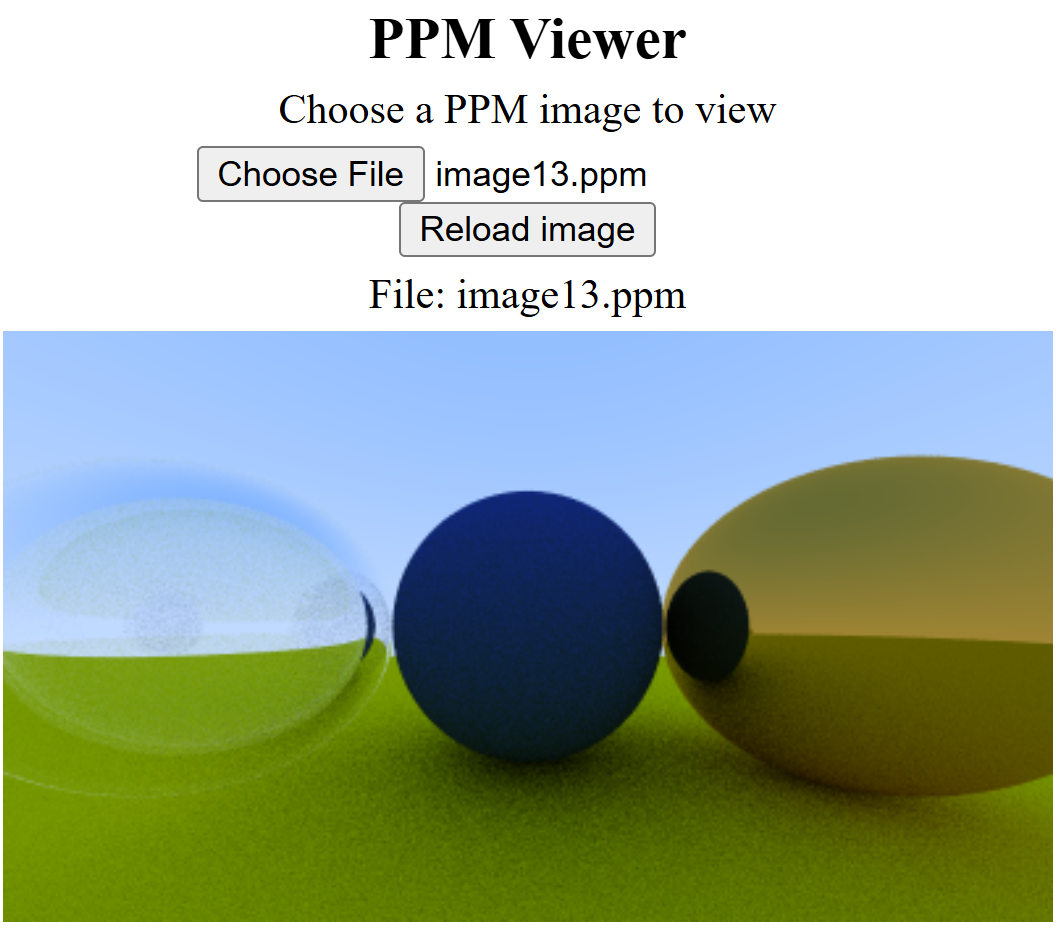
#### Add new material in main() and add a hollow glass sphere
```cpp
void main() {
// ...
auto material_ground = make_shared(color(0.8, 0.8, 0.0));
auto material_center = make_shared(color(0.1, 0.2, 0.5));
auto material_left = make_shared(1.50);
auto material_bubble = make_shared(1.00 / 1.50); // <<<<<<<<<<<<<<<<<<<<<<<<<<<<<<<
auto material_right = make_shared(color(0.8, 0.6, 0.2));
world.add(make_shared(point3( 0.0, -100.5, -1.0), 100.0, material_ground));
world.add(make_shared(point3( 0.0, 0.0, -1.2), 0.5, material_center));
world.add(make_shared(point3(-1.0, 0.0, -1.0), 0.5, material_left));
// >>>>>>>>>>>>>>>
world.add(make_shared(point3(-1.0, 0.0, -1.0), 0.4, material_bubble));
// <<<<<<<<<<<<<<<
world.add(make_shared(point3( 1.0, 0.0, -1.0), 0.5, material_right));
// ...
```
You are going to see output similar to the following: